








Design Tips, Luxury Furniture
The Real Cost of a Cheap Sofa: Why Quality Furniture Is a Smarter Investment
May
·
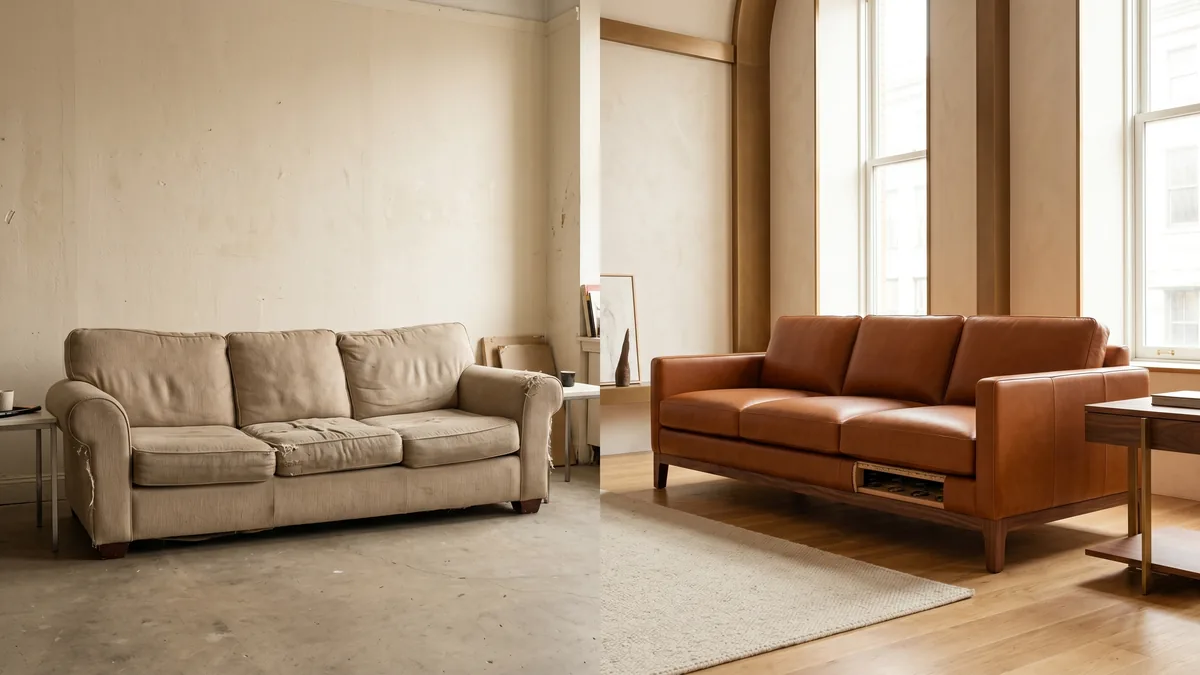
A $700 sofa from a big box retailer feels like a bargain right up to the moment the cushions go flat. That moment arrives faster than most homeowners expect: 18 to 36 months of normal use, according to Consumer Reports furniture longevity data. Run the math over 15 years (the lifespan a quality sofa should reach) and the cheap sofa usually costs more, not less. The real question is not is expensive furniture worth it. The question is what does it cost to replace a $700 sofa five times. Our team has unpacked the same logic for leather sofas as a long term investment, and the numbers are even sharper there.
What follows is a calm, line by line cost comparison between a $700 budget sofa and a $4,000 quality sofa over 15 years, plus the construction details that determine which category a sofa actually belongs to. Bring this article to the showroom; the sales associate will do the rest.
In this article
- How long should a sofa last (and what the data actually says)
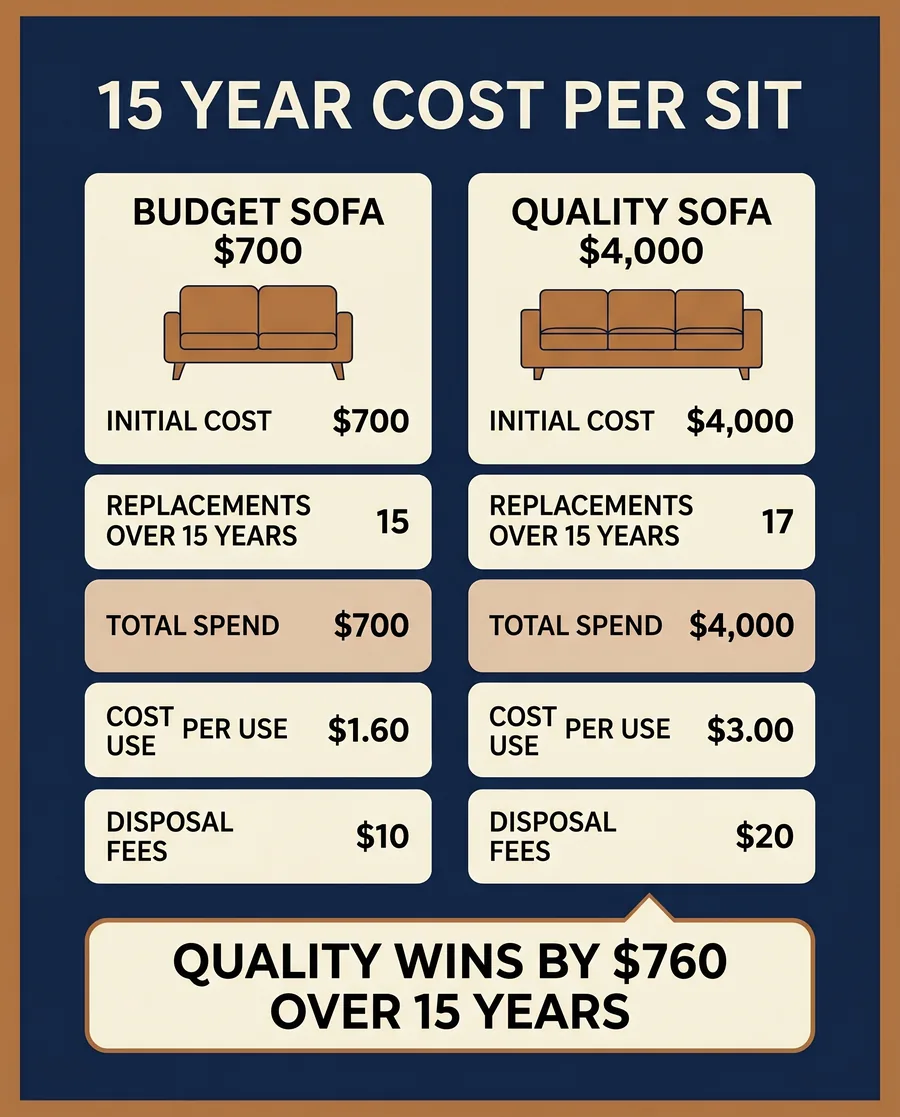
- The math: $700 versus $4,000 over 15 years
- What actually fails first on a cheap sofa
- What quality actually looks like on a showroom floor
- When a cheap sofa actually makes sense
- When to spend up: the three pieces that justify the premium
- Frequently asked questions
How long should a sofa last (and what the data actually says)
Consumer Reports tracks furniture longevity through annual member surveys. The headline numbers: a budget sofa under $1,000 averages 5 to 8 years before noticeable cushion sag and frame creak. A mid range sofa from $1,500 to $2,500 averages 10 to 12 years. A premium sofa over $3,000 averages 15 to 25 years if maintained. Furniture and woodworkers trade groups publish similar findings.
What changes those numbers, in order of impact: the frame material (kiln dried hardwood vs particleboard), the spring system (eight way hand tied vs sinuous vs webbing), and the cushion foam density (1.8 lb HR vs 1.5 lb commodity). Upholstery is fourth on the list, because most quality sofas are designed for the cover to be replaced or reupholstered after 12 to 15 years.
The math: $700 versus $4,000 over 15 years
Set aside taste for a moment. Here is the cash flow.
| Line item | Budget sofa ($700) | Quality sofa ($4,000) |
|---|---|---|
| Initial purchase | $700 | $4,000 |
| Average lifespan | 3 years | 15 years |
| Replacements in 15 years | 5 | 0 |
| Disposal fees (Toronto bulky pickup) | $240 ($60 x 4 disposals) | $0 |
| Reupholstery in year 12 | N/A (frame cannot be reupholstered) | $1,500 (optional) |
| Total spend over 15 years | $3,740 | $4,000 (or $5,500 with reupholstery) |
| Cost per day of use | $0.68 | $0.73 |
The two columns end up within five dollars per day. But the budget column hides the soft costs: five delivery days off work, the weekend you spend at IKEA assembling the replacement, the photo shoot you delayed because the cushions look terrible, the back pain that compounds over six years on cushions that compressed two years in.
What actually fails first on a cheap sofa
Cheap sofas do not all fail the same way. The failure pattern, in order of frequency:
- Cushion compression (12 to 24 months). Low density polyurethane foam loses 30 to 40 percent of its rebound after about a year of daily use.
- Frame creak and wobble (24 to 48 months). Stapled particleboard joints loosen, especially under cushions where weight transfers diagonally.
- Spring or webbing failure (36 to 60 months). Webbing stretches and snaps. Sinuous springs lose tension at the clip.
- Upholstery pilling and seam failure (24 to 60 months). Polyester and bonded leather pill, peel, or crack.
- Total frame collapse (4 to 7 years). A back rail fails, usually catastrophically, ending the sofa.
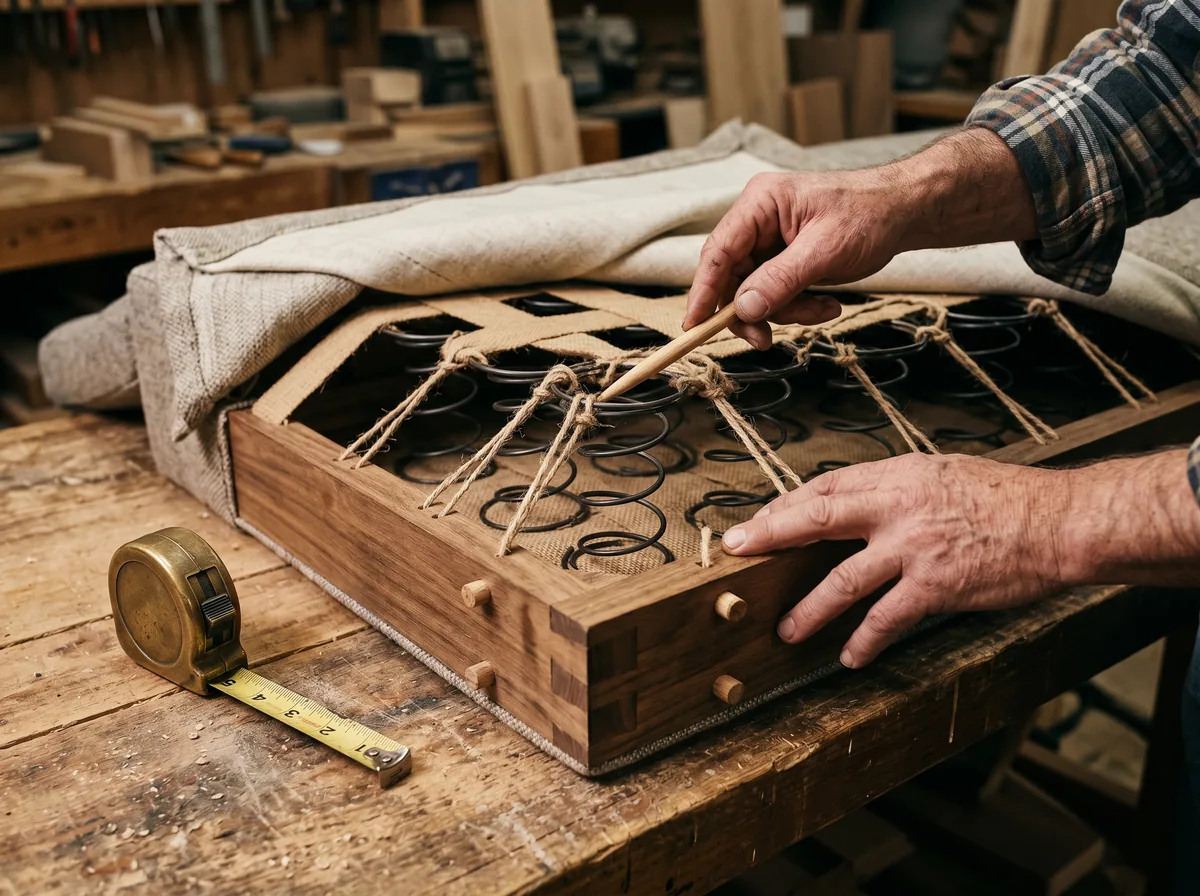
The same components on a quality sofa: 1.8 lb high resilience foam topped with a feather wrap, kiln dried hardwood with double dowelled corners and steel hardware, eight way hand tied springs that retain tension for 25 plus years, and top grain leather or performance fabric that develops a patina rather than wearing out.

What quality actually looks like on a showroom floor
You cannot evaluate a sofa from a photograph or a thumbnail on a website. Some checks have to happen in person.
- Lift one front corner. A three seater frame should be 90 to 130 pounds. Lifting a 70 pound sofa with one hand should make you suspicious.
- Press into the seat near the front rail. 1 to 2 inches of give, springy rebound. More give means low density foam.
- Look under the seat cushions. Eight way hand tied is visible as a grid of coil springs tied with twine. Sinuous looks like zig zag steel. Webbing alone is the bottom of the barrel.
- Check the cushion label. 1.8 lb HR foam with feather/down topper or 100 percent down on top of foam are both excellent.
- Run a fingertip along a seam. Stitches should be tight, even, 8 to 10 per inch. Loose stitching is your future seam failure.
When a cheap sofa actually makes sense
Quality is not always the answer. A cheap sofa makes sense in three specific cases:
- You are renting and might move within 2 years. Disposal logistics matter more than longevity.
- The sofa is for a basement or rec room used a few hours a week. Light use means a cheap sofa might last close to a quality one.
- You are still figuring out your style. A $600 placeholder for a year while you decide between a chesterfield, a sectional, and a tuxedo is rational.
For the main living room sofa in a home you plan to live in for 5 plus years, the math almost always favours quality. Buy one sofa once and hold it.
When to spend up: the three pieces that justify the premium
If you are budgeting room by room, three pieces deserve the largest share: the sofa, the bed, and the dining table. All three are used daily, all three are large enough to set the tone of the room, and all three depreciate gracefully when bought well. Everything else (side tables, accent chairs, lamps) can be dialled up later.
If your budget is tight today, buy the quality sofa now and live with placeholder side tables and a basic rug for 12 to 18 months. The opposite (designer side tables next to a sagging cheap sofa) reads worse than a quality sofa surrounded by basics.
The Quality Sofa Buyer’s Field Guide (Free PDF)
A printable in store inspection checklist for evaluating sofa frames, springs, fills, and upholstery.
Download the free guideFrequently asked questions
How long should a quality sofa last?
A sofa with a kiln dried hardwood frame, eight way hand tied springs, and 1.8 lb HR foam should last 15 to 25 years with normal household use. Reupholstery at year 12 to 15 can extend the lifespan by another decade.
Is leather or fabric a better long term investment?
Top grain leather lasts longer (20 plus years) and develops a patina that actually improves over time. High end performance fabrics (Crypton, Sunbrella) last 12 to 15 years and clean more easily. Both beat budget polyester.
What is the minimum I should spend on a sofa I plan to keep?
For a sofa you will use daily for at least 10 years, $2,000 is roughly the floor for build quality that supports that timeline. Below $1,500, the materials and joinery shortcuts catch up to you within 5 years.
Why does an Italian or Canadian made sofa cost more than the same size from overseas?
Higher labour costs, kiln dried North American or European hardwoods, eight way hand tied springs that take an experienced upholsterer about 90 minutes per sofa, and stricter material standards. The cost is in the inputs and the hours.
Can a cheap sofa be made to last longer?
Marginally. Foam toppers, slipcovers, and rotating cushion fills add 12 to 24 months. None of these fix a stapled particleboard frame, which is what actually fails first.
What is the smartest way to budget for a quality sofa?
Treat it like a 15 year capital purchase. Divide the price by the years and the days of use. A $4,000 sofa over 15 years is about 73 cents a day. Compare that to a daily coffee.
Keep reading
Run the numbers, then come see the difference. Browse our sofa collection or visit our Toronto showroom for a side by side feel test of a budget frame versus a hand tied hardwood frame. Our team ships across the GTA, including Mississauga, Oakville, and Vaughan, and across Canada.