








Design Tips, Latest Trends, Modern Furniture
Beyond the Black Box: How to Stylishly Integrate a TV Into Your Living Room
May
·
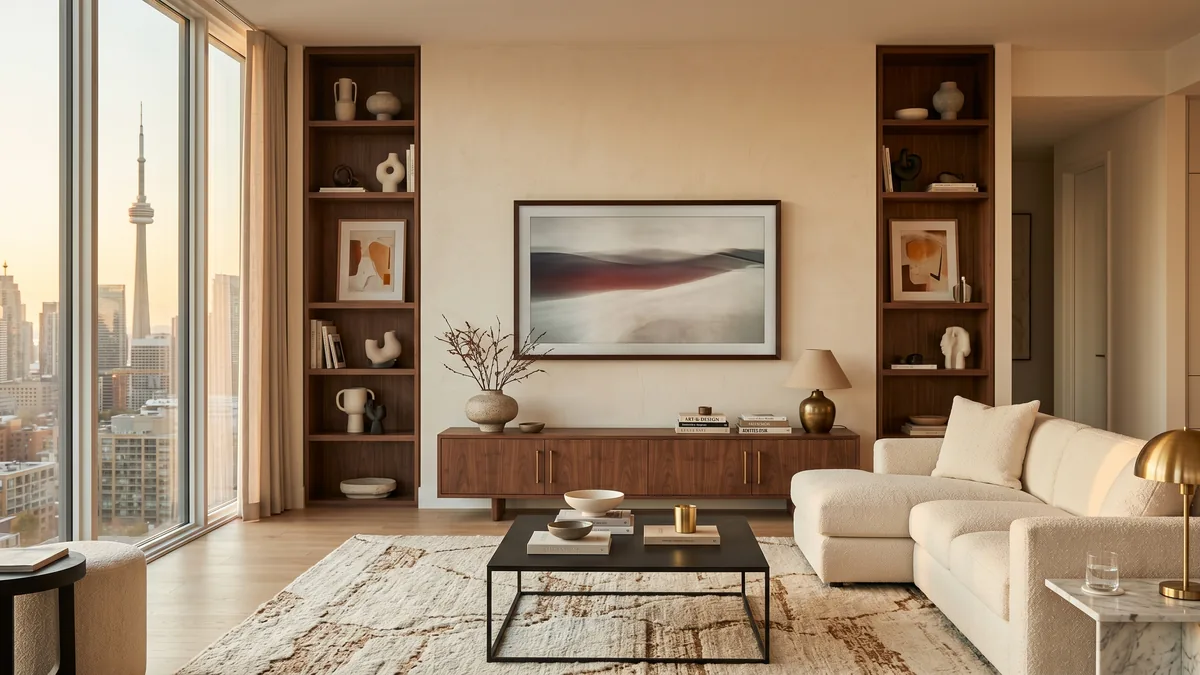
You can buy a beautiful sofa, install the right lighting, choose a rug that ties the whole room together, and still walk in to a living room dominated by a 65 inch black rectangle. The TV always wins the staring contest. The fix is not to hide the screen completely. It is to integrate it so the rest of the room can do its job. For more help laying out the seating side of the equation, our team has covered luxury living room furniture in Toronto in detail, and the same principles apply to any modern home in Toronto, Mississauga, Vaughan, or anywhere across the GTA.
What follows is the playbook our designers use when a homeowner says “I love my room, but the TV is killing it.” Five concrete moves, in order of effort and cost, plus the two mistakes that almost always make the problem worse.
In this article
- Why the TV dominates and what your eye is actually doing
- Move one: anchor the TV with a low, wide media console
- Move two: style the console like a console, not a TV stand
- Move three: build a salon gallery wall around the screen
- Move four: choose a frame style or matte panel TV
- Move five: built ins, recessed alcoves, and sliding art panels
- Two mistakes that make the TV look worse
- Frequently asked questions
Why the TV dominates and what your eye is actually doing
The brain pays attention to high contrast edges. A switched off TV is the highest contrast object in most living rooms: a hard edged black rectangle against a painted wall. Even when nothing is on, your eye keeps scanning back to it the way it scans back to a missing tooth in a smile.
Three forces make this worse: TVs have grown faster than living rooms (a 65 inch screen is now standard, up from 42 inches a decade ago), bezels have shrunk to almost nothing so there is no transition between screen and wall, and matte glass is rare. The good news: every fix below works because it lowers the contrast or breaks up the hard rectangular edge. You are not removing the TV. You are giving the eye somewhere else to land.
Move one: anchor the TV with a low, wide media console
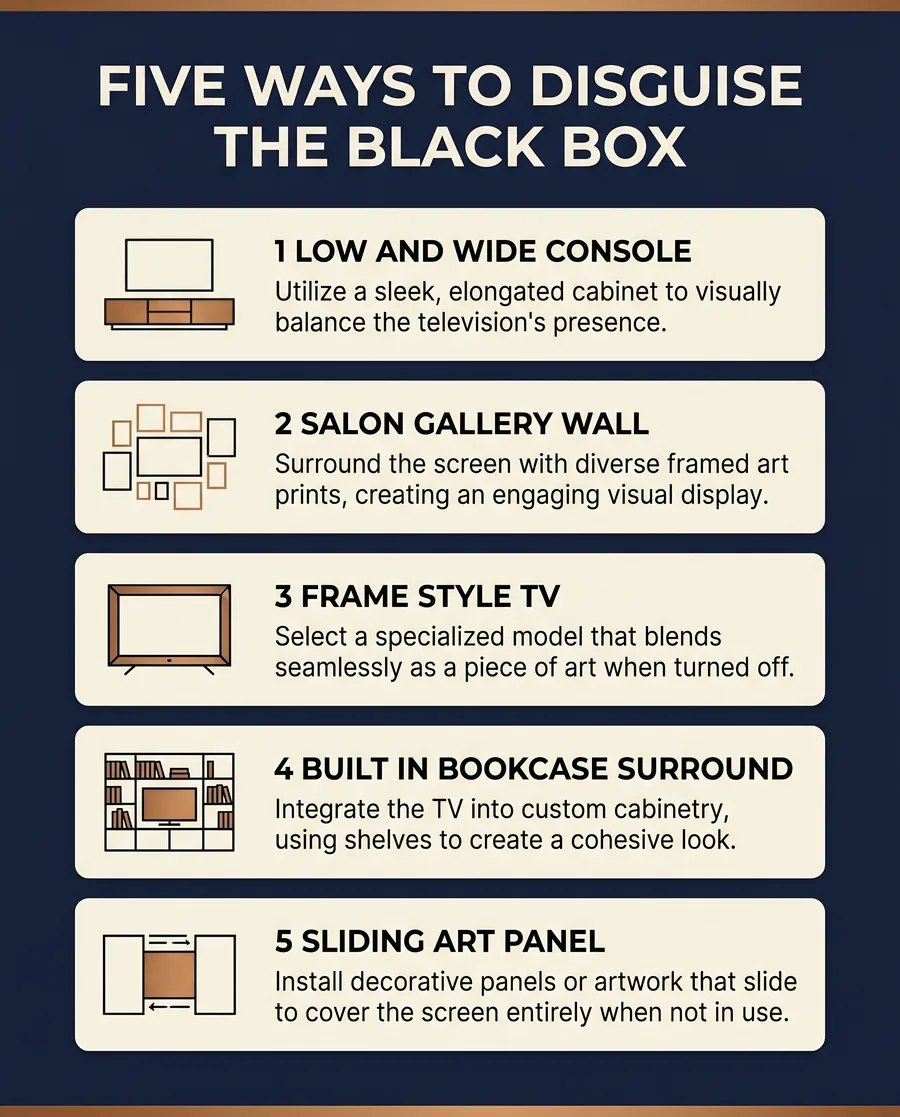
The single highest leverage move is also the cheapest. Replace any narrow modern TV stand with a media console that is at least 1.5 times the width of the screen, and no taller than 24 inches. A 65 inch TV (about 57 inches wide) wants a console between 84 and 96 inches long.
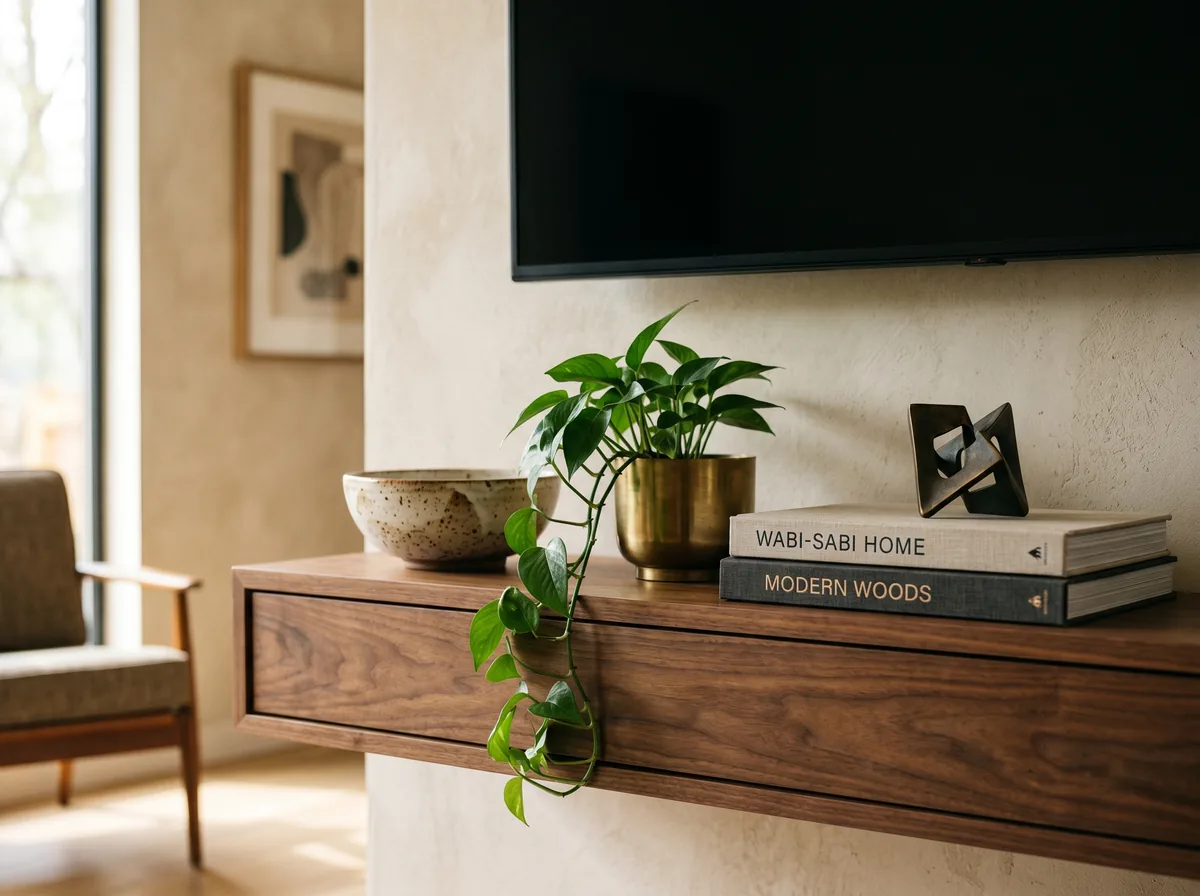
The width does two things. It gives the eye a horizontal line that is longer than the TV is wide, which visually demotes the screen. And it creates surface area to style. A long walnut or oak console with two stacks of books, a single ceramic vase, and a small brass table lamp will pull at least half the visual attention away from the screen even when it is off.
Material matters here. A high gloss white console competes with the screen. Walnut, matte black, fluted oak, and travertine all read more like furniture than electronics. Look for cable management channels in the back panel and adjustable shelves for any soundbar or set top box.
Move two: style the console like a console, not a TV stand
Most people stop here, and most people get this wrong. A bare console makes the TV look bigger, not smaller. A cluttered console makes the room feel chaotic. Designers split the surface into three visual zones and place objects in odd numbers (3 or 5) within each zone.
- Left zone: a tall element. A 14 to 18 inch table lamp with a linen shade, or a sculptural ceramic vase.
- Centre zone: often left empty if the TV is centred above. If you have asymmetric placement, add a horizontal stack of two design books topped with a small object.
- Right zone: a medium height piece (a small bust, a textured bowl, a wood box) plus one trailing element like a low philodendron or a small framed photo.
Vary heights and finishes within each zone. A ceramic bowl plus a wood sculpture plus a brass candlestick reads layered. Three brass items in a row reads showroom.
Move three: build a salon gallery wall around the screen
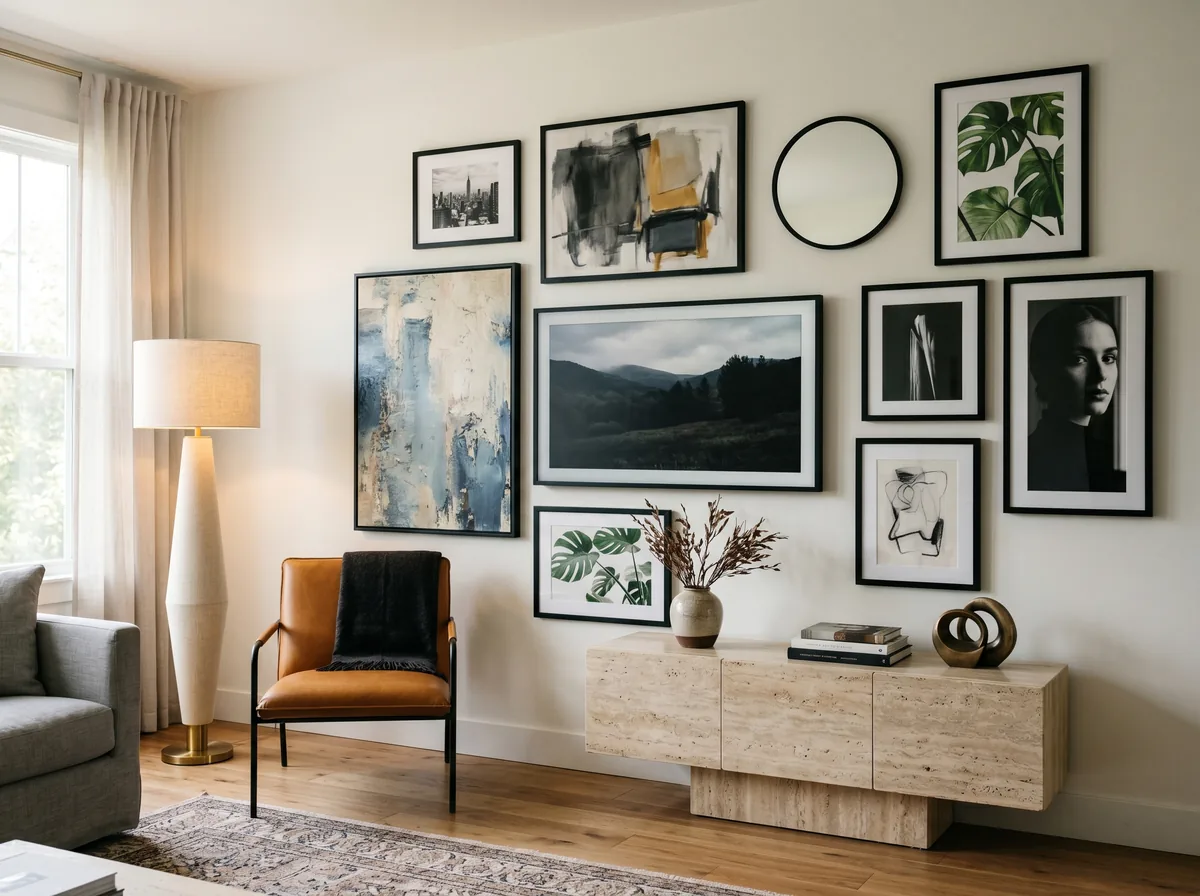
This is the move that turns a TV into one of nine things on the wall instead of the only thing. A salon style gallery wall mixes art, photography, mirrors, and the TV itself in matched matte black or matte brass frames of varying sizes. The TV becomes a horizontal rectangle in a constellation of rectangles.
The trick is to plan it on the floor first. Tape out the TV size on the wall, then arrange your frames on the floor in a 6 to 12 inch radius around the TV outline, varying orientation and scale. Aim for asymmetry, not symmetry. Photograph the layout from above, then transfer to the wall with paper templates.
Move four: choose a frame style or matte panel TV
If you are buying a new screen anyway, the hardware itself can solve a lot of the problem. Samsung Frame TVs, Hisense CanvasTV, and a handful of LG art mode panels use a matte anti reflective coating and a switchable art mode that turns the screen into a rotating gallery of paintings or photography when off. With a wood or rattan bezel kit, the TV passes for a framed piece from across the room.
The trade off: art mode TVs run a backlight to display the still image, which costs roughly 7 to 10 watts an hour. Over a year of evening use, that is about $12 in electricity at Toronto Hydro rates. Most people consider that a fair price for not having a black hole on the wall.
For HDR and 4K performance, frame TVs have caught up to mid range OLED panels in the last two years. They are still a step behind a high end LG C series for film purists, but for everyday viewing most homeowners cannot tell the difference.
Move five: built ins, recessed alcoves, and sliding art panels
The most expensive option is also the most permanent. Built in millwork that surrounds the TV with bookshelves, drawers, and a recessed central alcove turns the screen into one element in a cabinetry composition. A skilled millworker in Toronto will charge $8,000 to $25,000 for a wall sized run, depending on materials and depth.
For the same effect at a third of the cost, IKEA Pax with custom doors, Norse Interiors fronts on Sektion bases, and SemiHandmade panels can convert a flat pack system into something that looks bespoke. Plan the TV opening first; build everything else around it.
The most theatrical move: a sliding art panel that conceals the TV when not in use. A canvas, a wood slat panel, or a small tapestry on a barn door track slides across the screen on its own rail. When you want to watch, slide it open. The hardware (Frigerio, Real Sliding Hardware) costs $200 to $600 plus the cost of the panel itself.
Two mistakes that make the TV look worse
Mounting the TV too high. The single most common mistake in living rooms with a fireplace below the TV. When the centre of the screen sits more than 60 inches off the floor, your neck strains within 20 minutes. The fireplace mantel forces the issue, but it is almost always better to put the TV on a console beside the fireplace than above it.
Painting the TV wall a dark colour to “hide” the TV. It feels intuitive, but a black TV on a deep navy or charcoal wall does not disappear. The bezel still catches the light, and now the whole wall reads heavy. A warm white or putty mid tone with painted millwork or a salon gallery wall outperforms a dark accent wall every time.
Compare options below before committing to one approach.
| Approach | Effort | Approx. cost | Reversible |
|---|---|---|---|
| New media console + styling | Low | Starts at approx. $1,200 | Yes |
| Salon gallery wall | Medium | Starts at approx. $400 (plus art) | Yes (patch and paint) |
| Frame style TV swap | Low | Starts at approx. $1,500 | Yes |
| Built in millwork | High | Starts at approx. $8,000 | No |
| Sliding art panel | Medium | Starts at approx. $600 | Mostly |
The TV Styling Cheat Sheet for Modern Living Rooms (Free PDF)
A printable checklist for hiding, framing, or styling around the TV without a renovation.
Download the free guideFrequently asked questions
How high should a TV be mounted in a living room?
The centre of the screen should sit roughly 4 inches above the seated viewer’s eye level. For a sofa with a 38 inch seat back, that puts the centre at about 48 inches off the floor. Mount it higher only if the seating is much further back than 8 feet.
Should the TV be wider or narrower than the media console?
Narrower. A console at least 1.5 times the TV’s width grounds the screen. A 65 inch TV (about 57 inches wide) calls for a console between 84 and 96 inches.
Is a frame style TV worth the extra cost?
If you spend evenings in the living room with the TV off, yes. The matte coating and art mode change how the room feels when nothing is playing. If the TV is on most of the time, save the money and buy a better picture instead.
Can a TV go above a fireplace?
Only if the seating is at least 9 feet back and you can avoid mounting it more than 60 inches off the floor. Otherwise place the TV on a console next to the fireplace and keep the mantel for art.
What size TV is too big for a small condo living room?
Anything larger than 65 inches in a room under 200 square feet starts to feel oppressive. For Toronto condo living rooms in the 150 to 180 square foot range, a 55 inch screen on a styled console reads more luxurious than a 75 inch screen on the wall.
Do gallery walls around a TV go out of style?
Salon style gallery walls have been a fixture in European interiors since the 18th century. The frames you choose date faster than the format itself. Stick to matte black, thin brass, or warm wood and the wall will outlast three TVs.
Keep reading
Ready to swap that bare TV stand for a media console that earns its place in the room? Visit our Toronto showroom or browse our full media console collection online. Our designers can sketch a TV wall layout for your living room in Toronto, the GTA, or anywhere we ship across Canada.